Work events
Office Party Games That Survive Monday Morning
Published 27 August 2026
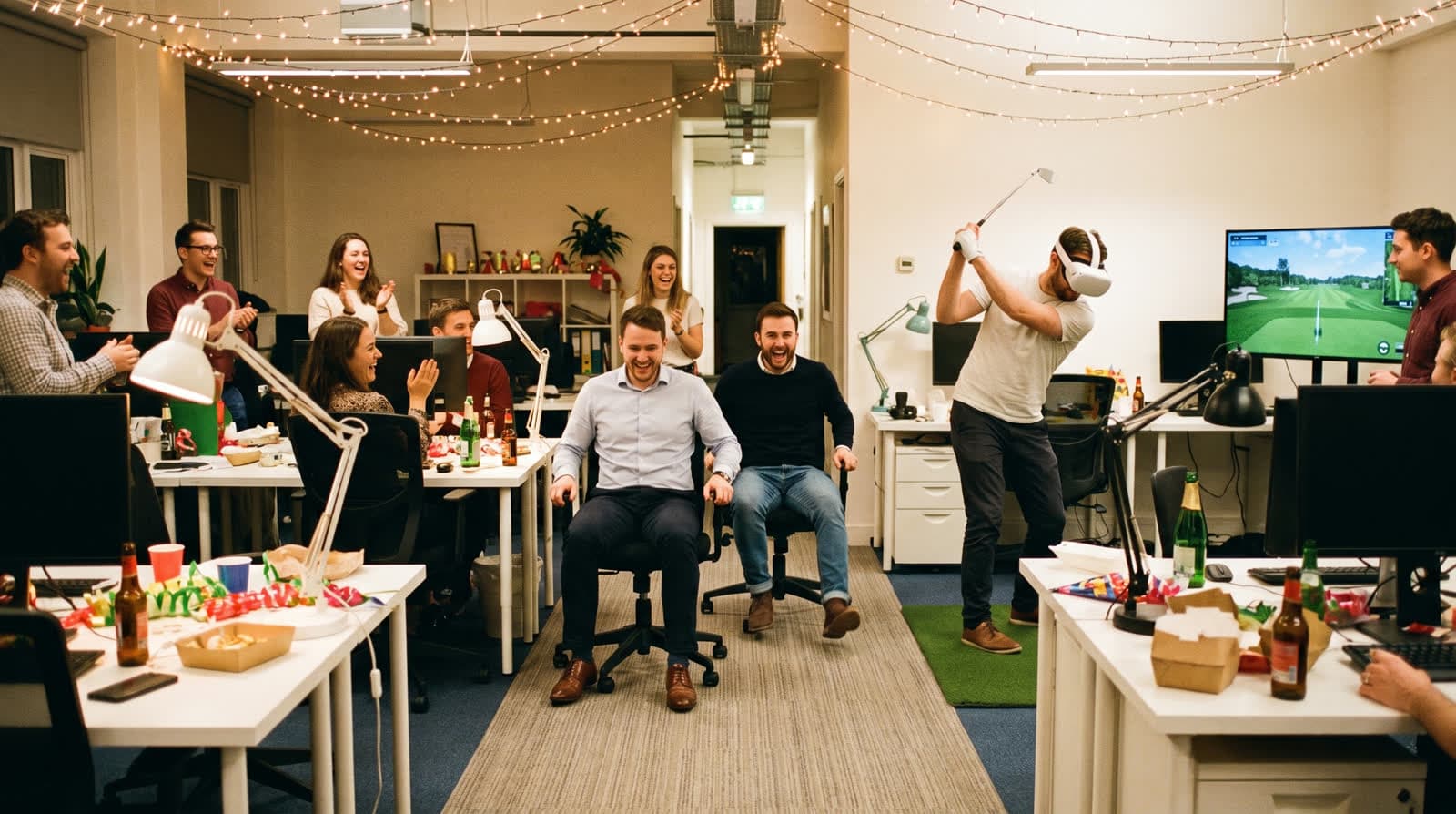
Search 'office party games' and you get two genres of nonsense: team building exercises wearing a party hat, and American listicles that assume you have a games room and a culture of consequence-free karaoke. This guide is about the actual office party — the leaving do, the summer social, the we-hit-the-target night — where the aim is that people enjoy themselves, nobody's development is being assessed, and everyone can still make eye contact at the nine-thirty stand-up. Games earn their place at these nights by giving people something to do that isn't standing near the kitchen holding a warm drink. Below: the filter that keeps you out of HR's inbox, then games sorted by the room you actually have — open-plan floor, meeting room, or a hired space.
First, the boundary: this is not team building
Team building is a working-hours activity with a development goal — communication, trust, the deliberate mixing of people who avoid each other. That territory gets a proper treatment in this guide to team building games for work, and none of it belongs at a party. The office party runs on different physics: it's after hours, attendance is socially rather than contractually expected, there's usually a drink in circulation, and nobody should be learning anything about themselves. The practical difference is direction of pull — at team building the facilitator's job is to draw the quiet ones in; at a party the host's job is to let anyone drift out of a game without it being noticed. One more boundary: this guide is deliberately not about December. The work Christmas party has its own budget arms race and its own politics, and it gets its own separate guide in work Christmas party ideas. What follows is for the other eleven months — leaving dos, summer socials, targets hit, anniversaries, the Friday the funding cleared.
The HR filter: what gets someone a meeting on Monday
Every game should pass one test before it gets near the invite: would it still sound fine described flatly, in an email to HR, by the least amused person in the room, on Monday morning. Not the most amused — the least. Most party-game disasters aren't caused by malice; they're caused by a format that needed everyone to be equally up for it, in a room where at least three people never are. The reliable offenders:
- Forfeits involving drink. The moment a game administers alcohol, it stops being a game and becomes a liability with rules. Prizes can be bottles; forfeits can never be drinking.
- Anything requiring touch. Human knots, piggyback races, blindfold guiding, three-legged anything. Consent at a work event is complicated enough without a game that assumes it.
- Truth formats. Never Have I Ever, Truth or Dare, 'most likely to' polls. These mine personal disclosure for entertainment, and at work the ore is toxic.
- Rating colleagues. Mock awards survive only if every award is vetted by two people who were sober when they wrote it. 'Best dressed' is a rating. Ratings end badly.
- Unvetted filming. A game that produces footage produces footage of people who didn't agree to be content. Camera games are opt-in, announced clearly, or not run at all.
- Nominated embarrassment. Any format where the entertainment is one specific person's dignity — karaoke by conscription, the boss in a spinning chair. Volunteered embarrassment is the best content a party has; assigned embarrassment is the Monday meeting.
None of this makes the party beige. It just moves the fun from 'what we found out about Dave' to 'what happened in the final of the chair race' — which is funnier anyway, and stays funny when retold in front of anyone.
Open-plan floor: games for the office you already have
No budget, no venue, just the office after half five on a Friday. The floor plan is the equipment.
- The desk-chair time trial. The one everybody remembers. Run it as a solo timed slalom — one chair, one course, one steward — never head-to-head racing, which is how monitors die. Clear the route, put the fire-exit aisle out of bounds, and have people propel their own chair: self-powered beats pushed, for both dignity and insurance.
- Wastepaper free-throw league. A bin, a line of tape, five throws each, running scoreboard on the whiteboard. Costs nothing, starts in ninety seconds, and the accounts team will quietly reveal a ringer.
- Desk mini-golf. Mugs on their sides, ramps built from ring binders, a nine-hole course snaking through the department. Putters optional — an umbrella works. Designing the course is half the entertainment.
- The office scavenger hunt. Teams of three, twenty minutes, a list that mixes the physical ('a stapler that actually staples') with the archaeological ('the oldest Post-it in the building'). Vet the list so no drawer containing anything personal is in scope.
- Paper aeroplane distance final. Two minutes of folding, one throw each, a tape measure. Engineering-adjacent colleagues become briefly unbearable; this is part of the appeal.
- Guess the desk. Close-up photos of five desks, owners' permission first, room votes on whose is whose. Surprisingly hard in a clean-desk-policy office; revealing in the other kind.
Meeting room: games for twenty people around a table
Twenty people, a big table, a screen. This is quiz country, but there is more than one format in it.
- The proper quiz. Six rounds, including one about the company that new starters can also win — company history, decoded jargon, real customer questions — not in-jokes with an audience of four. A quizmaster who rations their power is essential; see hosting, below.
- Baby photo or first-job guessing. Everyone submits in advance, the room matches photo to colleague. Gentle, opt-in by design, and the finance director's teenage metal band will surface eventually.
- Jargon Pictionary. Your own acronyms and stock phrases, drawn badly on a whiteboard. 'Synergy' has no known visual form; watching someone attempt it is the game.
- Colleague bingo. Cards of harmless, pre-vetted facts — 'has run a marathon', 'speaks three languages' — and you find the person who matches each square. It's mingling with a scorecard, which is the whole trick.
- Higher or lower: office edition. How many mugs in the kitchen, how many emails hit the support inbox in July, the corridor in metres. Facilities finally get to be the authority on something.
Hired room: formats that justify the venue
Once a hired function room enters the equation, DIY games start to look small in it. A hired space fits hosted formats: a race night with proper odds and fake money (hosted versions run roughly £300–£450 in the mainstream UK market, August 2026), casino tables played for chips and pride, a karaoke rig with a compere who keeps the queue honest, or a staged quiz with buzzers. The common thread is a professional running the room — which is genuinely what the hire budget should buy, because a colleague with a lanyard and a clipboard is not at the party.
Hosted VR sports tournaments are our corner of this market, so read the next sentence knowing who wrote it: MyVREvents brings hosted VR party hire to venues UK-wide — golf, racing, archery, clay shooting, tennis and drone flying on a live leaderboard, with the host, setup and travel included, and evening events from £395 for two hours. Each station needs a 3m x 3m patch and a socket, which most function rooms can spare, and the leaderboard quietly does the thing office parties find hardest: it gives strangers from different departments a reason to talk to each other.
Match the game to the occasion
| Occasion | Tone to hit | Formats that fit | Formats to skip |
|---|---|---|---|
| Leaving do | Warm, about the leaver | This-was-your-life quiz, guess-the-story, memory card wall | Anything competitive enough to steal focus from the guest of honour |
| Summer social | Loose, half outdoors | Scavenger hunt, garden games, free-throw league, rounders if there's grass | Long seated formats in a hot room |
| Milestone or target hit | Celebratory, all-in | Hosted tournament, race night, the big staged quiz | Anything needing three weeks of collected submissions |
| Promotion or small win | Low-key, one hour | Desk golf, one quiz round, higher-or-lower | Hiring anything — the moment passes before the invoice clears |
The pattern: match the game's weight to the occasion's. A leaving do built around a two-hour tournament isn't a send-off — it's a tournament the leaver happened to attend.
Running it: three decisions that matter more than the game
- Timing — games peak early. Run structured games in the first ninety minutes, while people are present, sober-ish and still wearing their name-remembering brains. After nine the appetite for rules collapses; anything still running should be finishing, not starting.
- Hosting — appoint or hire, never hope. Every format on this page dies without someone running it who is loud enough, organised enough and unembarrassable. Most offices have one such colleague at most, and they deserve a night off occasionally — which is the strongest argument for hosted formats, where running the room is precisely what you've paid for.
- Prizes — silly beats valuable. A £100 prize turns colleagues into competitors and the game into a dispute. A charity-shop trophy, a rotating champion's mug, a certificate printed at 4:55 — these sit on desks for years. The prize is the story, not the value.
- Participation — sixty per cent is a triumph. Some colleagues came to talk, and a party where everyone must play is a workshop with drinks. Favour games a crowd can watch — races, finals, leaderboards — and the non-players become the audience, which is participation too.
FAQs
What are good games to play at a staff party?
What office party games should you avoid?
Do work party games work without alcohol?
How many games should an office party have?
What games work for a big staff party in a hired venue?
Planning the event this guide describes?
Date, headcount, city — quotes back within one working day.