Comparisons
VR Golf vs Golf Simulator: Which Should You Hire?
Published 27 July 2026
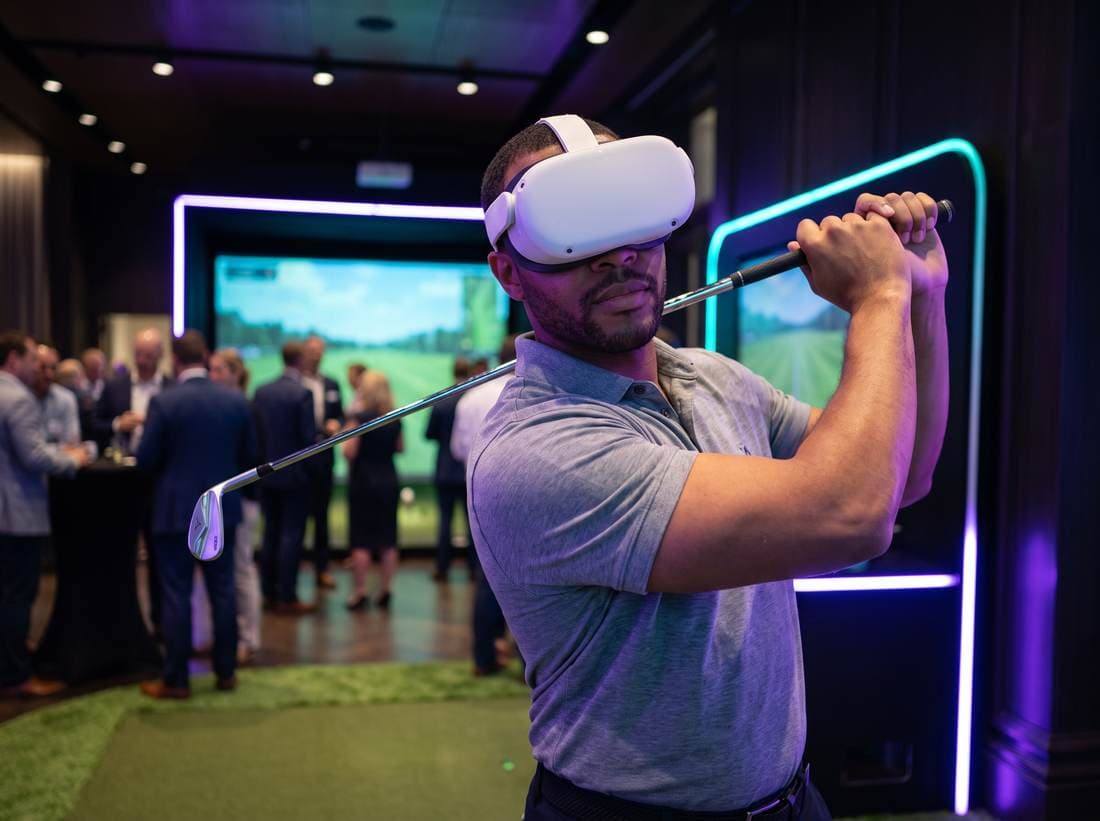
Both put golf indoors. Beyond that, VR golf and launch-monitor simulators are different machines for different jobs — and hiring the wrong one is an expensive way to find out. We run VR golf, so you know our angle; but the comparison below is honest enough that it sometimes talks people out of hiring us. Here's how to pick.
The two technologies, in one minute
A golf simulator is real equipment: you swing a real club and hit a real ball into an impact screen while a launch monitor (a Foresight GC3-class unit costs around £4,000 alone) measures spin, speed and launch angle to project the ball flight. A VR golf setup replaces all of that with a headset and a tracked swing — the club, ball and course exist in the headset, rendered as official recreations of St Andrews, Pebble Beach and the rest.
Head to head
| VR golf | Launch-monitor simulator | |
|---|---|---|
| Space needed | 3m × 3m | 5m × 7m enclosure, 3m ceiling |
| Setup time | ~1 hour | 2–3 hours |
| Kit on site | Flight cases by hand | Van-load: screen, enclosure, mat, PC |
| Real club & ball | No — tracked swing | Yes |
| Swing data (spin, launch, carry) | Gamified | Tour-grade |
| Guests per hour, per bay | 15–20 (short turns) | 6–10 (full shots, resets) |
| Spectator appeal | High — big screen + headset theatre | Moderate — familiar driving-range view |
| Weather/venue limits | Almost none | Needs the full bay footprint |
| Typical hire cost | From £395/evening hosted | From ~£150/hour + delivery/build |
Where the simulator genuinely wins
If your guests are serious golfers who want to feel a real strike and argue about spin rates, the simulator is the honest choice. Golf-society days, coaching events and golf-retail promotions belong to launch monitors — the data is the entertainment. The trade-offs are physical: a 5m × 7m footprint rules out most function rooms, the build takes hours, and one bay processes barely a fourball's worth of guests per hour.
Where VR golf wins events
Throughput, footprint and inclusiveness. A VR station fits where a simulator can't, sets up in an hour, and cycles guests three times faster — which is the difference between 'everyone played' and 'a queue watched four people play'. Crucially, the skill floor is lower: guests who've never held a club get airborne first swing, which keeps a mixed event's leaderboard competitive instead of humiliating. And formats — closest-to-the-pin, longest drive, team skins — run natively with a host and a big screen.
There's also the cost shape. Hosted VR golf starts at £395 for an evening including the host; simulator hire is typically priced by the hour (around £150/hr from the operators who publish) before delivery and build. For a two-hour party the totals can look similar — for a full day, they don't.
The throughput problem nobody mentions in the brochure
This is the single biggest cause of disappointing golf entertainment at events, and it's pure arithmetic. A simulator bay takes a full swing, a ball retrieval and a reset per shot; with a group of any size you're looking at 6–10 guests an hour through one bay. Invite 60 people to a two-hour drinks reception with one simulator and you have entertained, at best, twenty of them — while forty watched a queue.
VR stations cycle in two to four minute turns with no ball to retrieve, which puts 15–20 guests an hour through each one. Two VR stations comfortably handle a 60-person party; the same budget in simulator time would not. If your event is a reception, a party or a conference break, throughput isn't a technical detail — it's whether the thing works.
Setup time and what it does to your day
A simulator build is a 2–3 hour job: enclosure, screen, mat, projector or launch monitor, PC and calibration. That's fine when the venue gives you the room all day, and awkward when your slot starts at four and guests arrive at six. VR's roughly one-hour build from wheeled flight cases is the reason it fits office events, mid-conference activations and venues that hand you the room an hour before the doors open.
Access matters too. A simulator arrives as a van-load through a loading bay. VR arrives in cases that fit a standard goods lift — which is why VR golf ends up on the 24th floor of office towers and simulators, as a rule, do not.
The inclusiveness question
With a real club and ball, a complete beginner tops the ball, shanks it into the netting, and hands the club back embarrassed in front of colleagues. That's the honest failure mode of simulators at mixed events, and no amount of coaching patter fixes it in a two-minute turn. VR's forgiveness is a feature here: everyone gets the ball airborne, everyone posts a score, and the leaderboard stays a contest rather than a ranking of who already plays golf.
The flip side is real and worth stating plainly: that same forgiveness is why low-handicap golfers sometimes find VR unsatisfying. If your guest list is a golf society, believe them when they say they want the real thing.
The decision in four questions
- Who's playing? Mostly golfers → simulator. Mixed office/party crowd → VR.
- What's the room? Function room or office floor → VR. Sports hall or big marquee → either.
- How many guests? Over ~20 needing a go → VR's throughput wins.
- What's the point? Swing data and practice → simulator. Entertainment, contest and spectacle → VR.
Three events, three right answers
A golf club's member day. Simulator, comfortably. The audience plays, the data is the draw, and the club has the space and the build window. VR would feel like a toy to that room.
A 60-person office Christmas party in a function room. VR, without hesitation. The room can't take a 5m × 7m bay, the build has to happen in an hour, most guests have never held a club, and everyone needs a turn between dinner and the dancefloor.
A trade-show stand chasing footfall. VR again, for the throughput and the spectacle — the headset-and-big-screen combination stops passers-by in a way a hitting bay tucked behind netting doesn't, and quick turns keep the stand busy rather than blocked.
Rule of thumb: hire a simulator to impress golfers, hire VR golf to entertain a room. If your event is the second kind, VR Golf covers formats and courses, and our pricing page has the published numbers the simulator market mostly won't give you.
FAQs
Is VR golf realistic enough for proper golfers?
Which is cheaper to hire — VR golf or a golf simulator?
Can a golf simulator fit in a normal function room?
Can we hire both for the same event?
Planning the event this guide describes?
Date, headcount, city — quotes back within one working day.