Comparisons
VR Hire vs Casino Night: Which Owns the Evening?
Published 31 July 2026
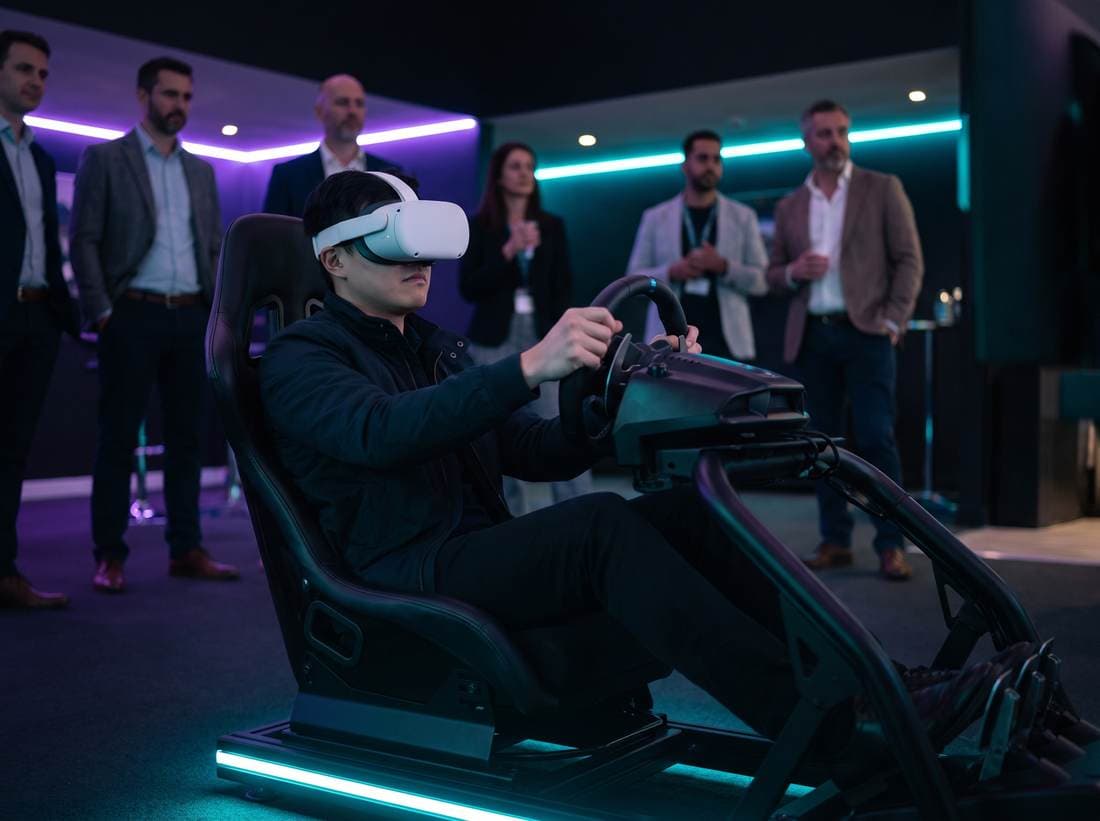
The fun casino is corporate entertainment's great survivor: blackjack and roulette tables, croupiers in waistcoats, funny money, a prize for the evening's biggest stack. VR is the newer bid for the same floor space and the same budget line. We operate the VR side, so treat our thumb on the scale accordingly — but the two formats genuinely suit different rooms, and picking wrong wastes an evening either way. Here's the comparison we'd want if we were booking.
What each format actually does to a room
A fun casino is ambient entertainment. It doesn't have a schedule; it hums along all evening as guests drift between tables, drinks in hand, playing for twenty minutes and wandering off. Its gift is texture — a room with casino tables never feels empty, and conversation happens naturally over the baize. Its limit is that it rarely produces a moment: nobody gathers, nothing crescendos, and by ten o'clock the tables are furniture.
A hosted VR tournament is structured entertainment. It builds through the evening — open qualifying, a filling leaderboard, finals with the room gathered round a screen — and produces exactly the crescendo the casino lacks. Its cost is that structure: it wants a slot in the running order and a compère moment, and it asks slightly more of guests than leaning on a table ever does.
Side by side
| Fun casino | Hosted VR | |
|---|---|---|
| Typical UK price (evening) | £400 – £800 for 2–3 tables | From £395; multi-station from £795 |
| Guest mode | Drift in and out, no commitment | Scored turns, building competition |
| Peak moment | None by design — steady hum | Finals on the big screen |
| Space per unit | ~2m × 1.5m per table | 3m × 3m per station |
| Staff included | Croupiers (usually 1 per table) | Host runs the whole format |
| Age and mobility range | Excellent — anyone can sit and play | Very good — standing turns, ~8 up |
| Dress-code friction | Zero | Zero — no kneeling, heels fine |
| What survives the night | Funny-money anecdotes | The leaderboard screenshot in the group chat |
Casino pricing reflects mainstream UK fun-casino hire, July 2026 — licensed for entertainment only, no real stakes, which is what keeps it legal and HR-approved.
Where the casino genuinely wins
- Cocktail-hour events with no running order. If the brief is 'elegant hum, no schedule', tables deliver exactly that and VR's structure has nothing to attach to.
- Very mixed physical abilities. Everything happens seated at a table — the most accessible format in corporate entertainment, full stop.
- Black-tie aesthetics. Waistcoats and roulette wheels photograph like a Bond set. A gala dinner's drinks reception is the casino's natural habitat.
- Rooms full of strangers. A blackjack table seats seven people who've never met and gives them a shared activity with zero exposure. It's networking with props.
Where VR takes the evening
- Parties that need a centrepiece. Christmas dos and team celebrations want a moment the whole room shares. Finals-on-the-big-screen is that moment; croupiers can't manufacture one.
- Competitive cultures. Sales floors and sports-mad teams want rankings, not ambience. A leaderboard with names on it feeds that for hours.
- Events that must be talked about afterwards. 'Dave won at fake roulette' is not a story. 'The new graduate beat the MD in the final by four points' is retold until Easter.
- Daytime and dry events. Casinos read oddly at 2pm without a drink in anyone's hand. Tournaments run identically at any hour, which is why the team building version exists at all.
The combination, and the budget truth
Big evenings run both without conflict, because they occupy different registers: tables humming through the drinks and dinner lulls, the tournament claiming its forty-five minutes of focus, then the casino absorbing the post-finals energy. If the budget forces a choice, decide by the room's shape — a standing reception with no schedule leans casino; a seated dinner with a dead hour after dessert leans tournament, and our Christmas party page explains why that dead hour is the whole battleground. On pure cost the formats overlap almost exactly, so price won't decide it for you; the UK cost guide has both markets' numbers if you want them.
Endings: the detail that separates the two
How each format finishes deserves more weight than it gets in the brochures. A casino night ends administratively — chips counted, a winner announced to a room that has mostly stopped paying attention, a bottle of fizz handed over. Done well it's a pleasant beat; done lazily it just evaporates. A tournament ends theatrically by construction, because the whole format has been narrowing toward a final the room watches together. If your event has a natural closing moment already — speeches, awards, a band's first song — the casino's soft fade fits neatly underneath it. If the evening has no climax planned, the tournament supplies one, and that difference is worth more than any line on the quote.
Questions that expose a weak supplier — either kind
For casino hire: are croupiers experienced entertainers or students in waistcoats (ask how they handle a dead table); are tables full-size or the smaller party versions; what's the funny-money and prize mechanic, since a limp ending is the format's classic failure. For VR hire: is a host included or an upsell; what happens with a queue of thirty; how is hygiene handled between users; and does the price include the leaderboard and finals staging or just the kit. Both markets contain operators who deliver equipment and call it an event — the host or croupier quality is the actual product.
FAQs
Is a fun casino or VR hire cheaper?
Is fun casino hire legal for work events?
Which works better for a Christmas party?
Can you run VR and casino tables at the same event?
Which suits a networking event best?
Planning the event this guide describes?
Date, headcount, city — quotes back within one working day.