Weddings
Wedding Entertainment Ideas: What Works, What It Costs, and the Hours Nobody Plans
Published 27 August 2026
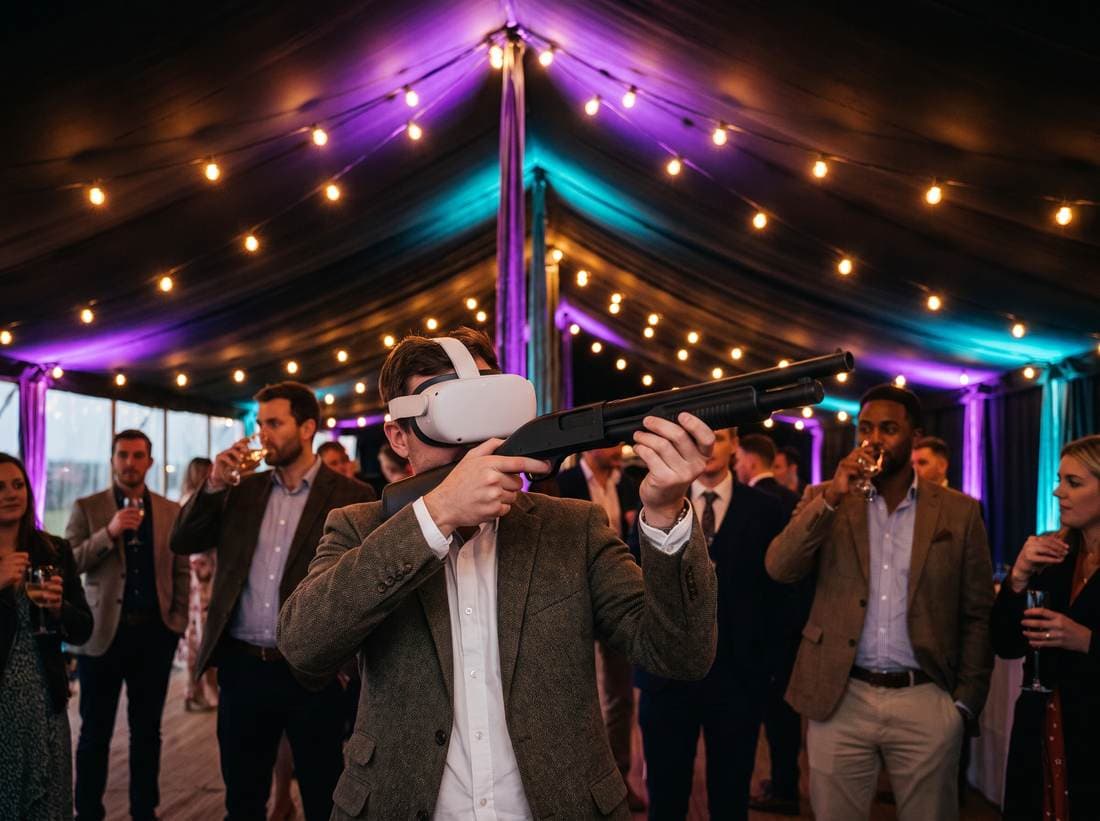
Every wedding has the same soft spot: the couple disappear for photographs, the speeches have finished, the band isn't on for two hours, and a hundred and twenty people who mostly don't know each other are standing around with drinks. Some couples solve it with lawn games. Some hope for good weather. This guide covers the whole menu — bands, DJs, booths, casino tables, games for guests and the newer options — with honest UK costs for each, plus a plan for the two gaps most couples forget entirely: the photography hour and the evening buffet lull.
The problem you're actually solving
Wedding entertainment isn't about spectacle. It's about the ninety minutes when nothing is scheduled and the room's energy either holds or drains away. Guests who were seated together now have to mingle, and the ones who don't know anybody gravitate to the bar or their phones.
What fixes that is something with a shared focal point — a reason for two strangers to end up talking about the same thing. A leaderboard does that better than almost anything, because it gives everyone in the room a stake in what's happening without requiring them to participate.
Wedding entertainment ideas, ranked
Ranked by what they add to the day per pound, not by glamour. Every wedding needs a musical backbone — that's the band-or-DJ decision — and then, honestly, one more thing aimed at the hours the music doesn't fill. The costs below are what the mainstream UK market actually charges, not what directories advertise.
| Idea | Typical UK cost | The honest verdict |
|---|---|---|
| 1. Function band | £1,200–£3,500 | The biggest single lift a reception can buy, priced accordingly. Worth it when dancing is the whole point of your evening. |
| 2. DJ | £400–£900 | The value backbone. The difference between £400 and £900 is mostly how well they read a room, which is the entire job. |
| 3. Lawn games | £100–£250 hire | Cheapest smiles on the list. Entirely weather-dependent, and someone ends up fetching quoits out of a hedge. |
| 4. Photo booth | £350–£600 | The default for a reason. Queues hard for two hours, then sits quiet — time it to open as evening guests arrive. |
| 5. Close-up magician | £350–£650 | Built for the drinks reception — works the room table by table, which is exactly where the mingling problem lives. |
| 6. Hosted VR sports | From £395 | Indoors, all ages, leaderboard-driven, and the spectating carries it. Covered in detail below — declared interest and all. |
| 7. Fun casino | £400–£800 | Two tables and croupiers. Gives non-dancers a home all evening; nobody wins real money, which your uncle will query. |
| 8. Silent disco | £350–£700 | Solves a noise curfew and settles the playlist argument three ways. A room singing with no audible music is the show. |
| 9. Singing waiters | £700–£1,500 | One genuinely great ten-minute reveal. You're paying per minute roughly what a band costs per hour. |
| 10. Caricaturist | £300–£500 | Slow — about ten drawings an hour — but the only entry on this list guests take home and keep. |
Mainstream UK market, August 2026. London, Saturdays and peak season sit at the top of every range; midweek and winter bookings sit near the bottom.
A word on 'unique wedding entertainment', the most-searched and least-honest phrase in this industry. Nothing bookable is unique — if a supplier exists, other couples have booked them. What guests remember isn't novelty, it's participation: grandad topping a leaderboard beats a fire-eater nobody talks to. Pick whichever option the most of your particular guests will actually do, and it will feel unique to them, which is the only version of unique that matters.
And the declared interest, in full: hosted VR sports is what we do — VR sports tournaments brought to venues UK-wide, with golf, clay shooting, racing, archery, tennis and drone flying on the menu. Evening bookings start at £395 for two hours with one experience — the full rate card is on the pricing page — and a host, leaderboard, travel and setup are always included. Each station needs a 3m × 3m corner and one ordinary socket, players from roughly age eight up can join in, and we're not VAT registered, so no VAT lands on top. That's photo-booth money for something considerably more of the room will actually have a go at.
Wedding games and activities for guests
Games are the budget end of wedding activities for guests, and pound for pound they outperform almost everything in the table above. The test of a good one: can a guest who knows nobody join within thirty seconds of walking past? If it needs a rules briefing, it's a game for the wedding party, not the wedding.
- The shoe game. Free, ten minutes, and the best return in all of wedding entertainment. The couple sit back to back holding one shoe of each and raise them to answer questions — 'who texted first?', 'who's the better driver?'. Every generation understands it instantly and the photographs are reliably the best of the day.
- A table quiz about the couple. Free. One sheet per table during the meal, questions the couple wrote themselves, a prize worth stealing. It gives tables of half-strangers something to argue about, which is the entire social battle won.
- Guest bingo. Free to print. Squares like 'find someone who went to school with the bride' or 'find the person who travelled furthest' — it licenses strangers to talk to each other, which British guests will not otherwise do.
- A photo scavenger hunt. Free via guests' phones. A card of ten shots to capture — the hug, the worst dance move, all the cousins in one frame — and you end the night with a photo set the photographer couldn't have got.
- Lawn games, done honestly. £100–£250 to hire giant Jenga, croquet, boules and connect four. Glorious in sunshine, landfill in drizzle — have an indoor plan for the same hour, because a Great British forecast is not a plan.
- The speech sweepstake. Free and quietly brilliant. Guests put a pound on the best man's running time and the nearest guess takes the pot. It turns the longest speech from an endurance event into live sport.
- Advice cards and the anniversary jar. A tenner in stationery. Less a game than an activity, but it occupies the quiet corners of the room and produces the one thing from the day you'll actually read in five years.
None of these run themselves. Every game on that list needs an owner — usually an usher with a loud voice and no shame — because the difference between an activity and an awkward pile of printed cards is one confident person proposing it.
Evening entertainment that survives the buffet lull
Evening wedding entertainment has one specific enemy, and it isn't the budget. Somewhere between eight and ten the buffet opens, the day guests are flagging, the evening guests have just arrived knowing nobody, and the dance floor empties because everyone is holding a paper plate. Bands call it playing to the sausage rolls. Every reception has this lull; almost nobody plans for it.
What survives the lull is anything a guest can do with a drink in one hand and drop in and out of. Casino tables thrive on it — grazing and gambling are natural partners. The photo booth queue rebuilds. Anything with a leaderboard turns eaters into an audience, because watching is participation you can do mid-sausage-roll. What dies in the lull is anything that needs the whole room's attention at once: this is the wrong slot for surprise acts, a second round of speeches, or the band's opening number.
- Give the band's first set to the post-buffet slot. The band is the expensive thing; don't spend their best hour on a chewing audience. Let the DJ or a playlist carry the lull.
- Cut the cake as the buffet opens. It's the one moment that legitimately gathers the room mid-lull, and it fires the starting gun on the food.
- Aim the interactive entertainment at the lull deliberately. A booth, casino tables or a tournament running eight till ten gives evening guests something to do that isn't standing at the bar auditing strangers.
- Stage a finale at half nine. A last-round announcement — chips counted, leaderboard settled — herds everyone back into one room at exactly the moment the band needs them.
Why VR suits a wedding specifically
Of everything on the ranked list, the one couples have usually never seen at a wedding is the VR tournament, so here is the case for it, made honestly.
- It works indoors. No forecast to check, no plan B, no lawn game abandoned in the rain in a Great British June.
- Three generations can play. Grandparents genuinely have a go, which is not true of most alternatives, and the results are usually the story of the afternoon.
- Nobody has to change. Suits and dresses are fine. Swings are compact, racing is seated, and the host is practised at fitting a headset over a wedding hairstyle.
- It runs itself. You're not managing it. The host handles rotation, scoring and everyone who wants one more go.
- It's optional. Guests who'd rather watch, watch — and the spectating is genuinely the better half.
Where it goes at a wedding venue
One station needs a cleared 3m × 3m; two stations and a screen want about 6m × 4m. That's a corner of a marquee, a side room off the main hall, or the space the band will use later. Most wedding venues have somewhere that's empty during the gap you're trying to fill, which is convenient, because that's exactly when it's needed.
Marquees work well given three things: firm level flooring, cover from direct rain and a power supply agreed in advance. Grass settles as the day warms, so boarding is worth having. Any supplier worth booking will talk to the marquee company directly rather than leaving you to relay it — a spec conversation is two minutes for them and a headache for you.
Timing it around the day
| When | Why it works |
|---|---|
| During photographs | The classic dead hour. Guests are unoccupied and the couple aren't there to miss it. |
| After the speeches | Energy dips hard once the formal part ends. This lifts it before the evening guests arrive. |
| Evening reception | Gives non-dancers somewhere to be, which quietly keeps people at the party longer. |
| Before the first dance | A short finals round pulls everyone into one room at exactly the right moment. |
The photography gap is the most-booked slot, and the most useful. It's also the one couples most often forget to plan for, because they're not there to experience it.
Which VR experiences suit a wedding
VR clay shooting is the one to book first. It has all the theatre of a country clay line — the call, the arc, the satisfying hit — with no shotguns, no licences, no field and no weather. It reads as elegant rather than gimmicky, which matters at a wedding, and it's the format that gets three generations having a go.
VR golf is the close second and suits the same crowd. VR archery works beautifully in a smaller room and produces quick, quiet contests rather than shouting. Steer away from VR racing as the only option at a wedding — it's brilliant but it's the loudest, and a small minority find it uncomfortable, which isn't what you want in formal wear.
What the couple actually experience
Almost nothing, and that is rather the point. If it's booked for the photography gap, you're outside having your pictures taken while it happens. What you get is a room that's still buzzing when you walk back in, rather than one that's gone flat.
Couples who want to play usually do so later in the evening, and there's something reliably funny about a bride in a wedding dress taking a clay-shooting title off the best man. But the honest pitch is that this is entertainment for your guests during the hours you can't be with them.
Budgeting it honestly
Across the mainstream UK market in August 2026, couples booking a band plus one more thing typically land somewhere between £1,800 and £4,000 all-in on entertainment; a DJ-plus-one-thing wedding lands nearer £900–£1,800. Neither number is right or wrong — but the second purchase matters more than its price. More music doesn't fix the photography gap or the buffet lull; something aimed at a specific dead hour does.
Two rules keep the spend honest. First, interrogate what's included — travel, setup time and an operator are where cheap quotes quietly grow, so compare like with like using the cost guide, and favour suppliers who publish their rates over ones who make you request a quote to learn them. Second, above about eighty guests, one of anything interactive becomes a queue — budget for capacity, not just presence.
What to tell your venue
- One 13-amp socket per station — no special power, no three-phase, nothing for the venue to arrange.
- A cleared 3m × 3m per station, ideally away from the top table.
- Roughly an hour to set up, which can happen well before guests arrive.
- Pack-down happens around the party, usually while the dancing is still going.
- Public liability certificates supplied on request — most venues ask, and it's a two-minute email.
The short version
Book the musical backbone first, then buy for the gaps rather than the glamour: one thing for the photography hour, one plan for the buffet lull, and a couple of free games with a nominated owner. If the gap-filler is a VR tournament, put it in a side room or a marquee corner, choose clay shooting or golf, and let the host run it. The hours nobody plans are the ones everybody remembers.
FAQs
What is the best wedding entertainment on a budget?
How do I keep wedding guests entertained during the photos?
What evening wedding entertainment works if guests won't dance?
Will older guests actually take part in VR at a wedding?
How many guests can one entertainment station handle?
Planning the event this guide describes?
Date, headcount, city — quotes back within one working day.