Birthdays
30th Birthday Ideas: Plans That Survive the Group Chat
Published 27 August 2026
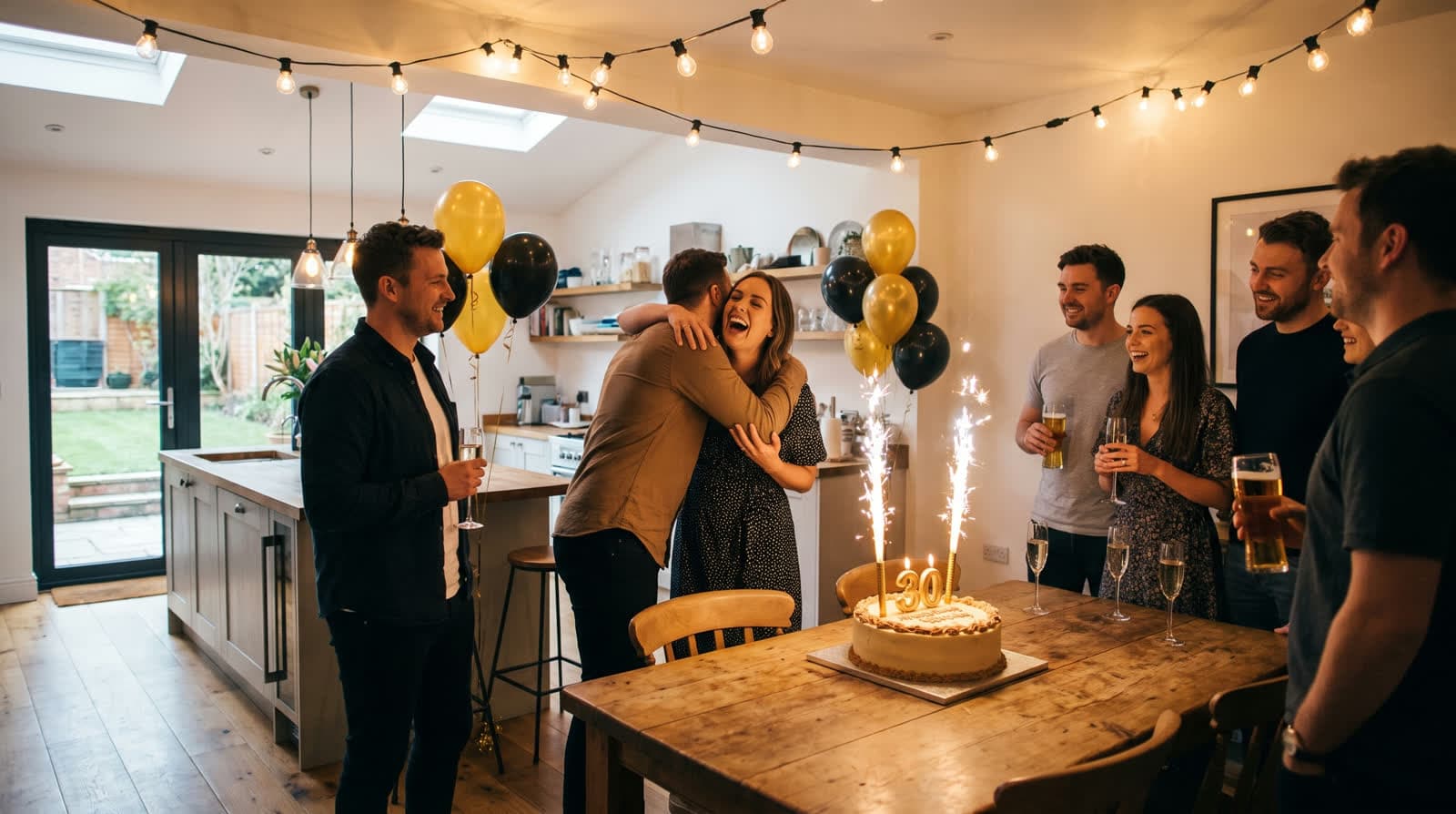
Your 18th was organised by your parents. Your 21st organised itself, because everyone you liked lived within a ten-minute stagger of the same student union. Your 30th is the first birthday you plan as a proper adult — which means you finally have money, and none of your friends live anywhere near you or each other. They have jobs in other cities, partners you've met twice, and in several cases small children with non-negotiable bedtimes. This guide is 30th birthday ideas for that reality: the four formats that actually work, the per-head maths on each, how to win the RSVP battle, and themes that don't require anyone to hire a costume.
Why the 30th is the hardest birthday you'll ever plan
The economics of birthdays invert somewhere around 26. At 21 you had no budget and infinite availability; at 30 you have an actual budget and a guest list whose diaries are booked solid six weeks out. Worse, you're planning in peak wedding territory — first marriages in the UK now cluster in the early thirties, so your summer Saturdays are competing with ceremonies people committed to a year ago. The practical conclusion: pick the date before the format, announce it eight to ten weeks ahead, and treat the choice of weekend as the biggest single decision of the whole event. A brilliant party on a bad date loses to an average party on a good one, every time.
First decision: which of the four formats you're throwing
Almost every 30th that works is one of four shapes: a big night out, a weekend away, a house party done properly, or an activity day. The classic mistake is trying to be two at once — the 'weekend away that ends in a big night everyone else joins' sounds inclusive and delivers two half-events, with the weekend crowd tired and the night crowd feeling like extras. Choose one as the main event. If you genuinely want both, run the weekend for the inner circle and a separate night for everyone else, and never apologise for the tiering.
The big night
Still the default, and still the right call when the guest list is long and scattered: a reserved area in a bar, 7pm until late, thirty to eighty people. Three things separate the good version from the forgettable one. First, an actual booked space with your name on it — 'we'll be near the back' dissolves within an hour of a busy Saturday. Most venues will hold an area against a minimum bar spend of roughly £600–£1,500 (mainstream UK market, August 2026 — less midweek, more in central London), which sounds alarming until you notice that forty adults clear it without trying. Second, food that circulates rather than a sit-down: a seating plan is where a mixed list of school friends, uni friends and work friends goes to die. Third, one deliberate moment — the toast, the cake, the mildly embarrassing photo reel. Without a moment it's just a Saturday; the moment is what makes it a 30th.
The weekend away
The inner-circle format: eight to fourteen people, a house big enough, two nights. The honest thing to say is that a weekend away is a filter, and the filter is its value — the price and the commitment sort your guest list into the people who'd cross the country for you and the people you'll see at the big night instead. Houses sleeping ten to fourteen run roughly £900–£2,500 for a weekend depending on season and hot-tub ambition, which lands around £120–£300 a head once travel and a food kitty are counted. Convention at this age is clear: everyone pays their own way, and the group quietly covers the birthday person. Plan one anchored activity per day and leave the rest empty — over-programmed weekends feel like work conferences with better wine.
The house party, done properly
Somewhere around 30 the house party stops meaning 'whatever happens after the pub' and becomes a real format — mostly because by now someone in your circle has a house with a garden. Done properly means hiring in the three things that turn a gathering into an event: drink you don't have to make (a keg, cases of something decent, or one batched cocktail), food that arrives at a fixed time rather than a table of crisps, and one piece of entertainment that isn't a playlist. Budget £500–£1,200 all in for thirty to fifty people — £15 to £40 a head, less than the big night's minimum spend, with no closing time and nowhere to queue.
On that entertainment slot, we should declare an interest: our own hosted VR sports hire at MyVREvents — golf, racing, archery, clay, tennis and drones, brought to venues UK-wide with a host, leaderboard, travel and setup always included — starts at £395 for a two-hour evening, needs a 3m x 3m corner and a normal socket, and works from roughly age eight up, which matters once friends start arriving with children. VR party hire has the detail. Interest declared; everything else in this guide works perfectly well without us.
The activity day
The quietly rising format, and the one that suits scattered friends best, because a 2pm start lets people travel in and out on the same day — and lets the ones with kids actually attend. The shape: one booked activity for two to three hours, then dinner for whoever stays on. Karting, crazy golf, a food tour, clay shooting, a competitive baking afternoon — anything with light structure and a scoreboard beats aimless afternoon drinking, because it gives thirty people who half-know each other something to do with their hands and a ready-made reason to talk. Expect £40–£90 a head for the activity across the mainstream UK market, August 2026, with guests self-funding by long-standing convention. For a deeper look at entertainment-led birthdays and what suits which ages, the VR birthday parties guide covers that ground properly.
The budget maths, honestly
| Format | Group size that works | Typical cost | Who pays, by convention |
|---|---|---|---|
| Big night (reserved bar area) | 30–80 | £600–£1,500 minimum spend, plus £200–£500 food | Host covers space and food; guests buy their own drinks |
| Weekend away | 8–14 | £120–£300 a head incl. house, travel, food kitty | Everyone self-funds; group covers the birthday person |
| House party done properly | 20–50 | £500–£1,200 all in (£15–£40 a head) | Host pays; guests bring bottles regardless |
| Activity day + dinner | 10–25 | £40–£90 a head for the activity | Guests self-fund; host picks up cake and extras |
Ranges reflect the mainstream UK market, August 2026, outside central London — add 20–40% inside it. Note the pattern: the format that costs the host most (the big night) is not the one guests remember longest.
The RSVP problem: getting people to actually come
Every 30th planner discovers the same thing: the hard part isn't the party, it's the attendance. You're competing with weddings, work, other people's 30ths and plain inertia, and the group chat's 'maybe' column is where events go to die. Tactics that measurably move the number:
- Send a date, not a poll. A five-option availability poll signals the event is negotiable, and negotiable events lose to fixed ones. Pick the date, announce it, and let the diary-clash casualties fall where they fall.
- Eight to ten weeks out, individually. Enough notice to book travel; not so much it gets filed under 'later'. A named, personal message outperforms a group-chat broadcast by a distance — broadcasts diffuse responsibility, and diffused responsibility never replies.
- Put a calendar invite behind it. A date sitting in someone's actual calendar defends itself against everything that arrives afterwards. A date sitting in a group chat defends nothing.
- Tier without guilt. Weekend away for the eight, big night for the eighty. Everyone understands tiers by this age — most of your guest list has done exactly this at a wedding, or is about to.
- Plan for 60–70%. That's a healthy conversion rate for a scattered 30-something guest list. Invite accordingly, and book the space for the number you expect, not the number you asked.
- Respect the wedding calendar. If your circle is deep in wedding years — and at 30 it is — a June Saturday is contested territory. Late spring and early autumn Saturdays convert noticeably better.
Themes that are not fancy dress
Fancy dress at 30 splits the room: a third love it, a third tolerate it, and a third quietly don't come. A theme's real job is to make the night feel decided — to shape the food, the music, the dress and the photos — and all of that is achievable without anyone hiring a wig:
- Born in 1996. Turning 30 in 2026 means a 1996 birth year — so the playlist, the sweets, the menu and a printed front page from the day you were born all come from it. Nostalgia does the decorating for you.
- Black tie for no reason. Everyone owns or can borrow the outfit, everyone looks better than usual, and the photos age brilliantly. The complete absence of a wedding is precisely the joke.
- One colour. A single-colour dress code costs guests nothing, unifies every photo, and takes ten seconds to explain on the invite. Pick a colour most wardrobes already contain.
- The tournament. Bracket on the wall, running scoreboard, trophy ceremony at the end. Works with darts, table tennis, a games console or hired kit — light competition is the fastest known route between strangers at a mixed party.
- The nostalgia menu. Your school-party food, catered properly: party rings, cheese-and-pineapple hedgehogs, a ceremonial Viennetta. Cheap, funny, and reliably the most photographed table of the night.
- Decades by playlist, not costume. Each hour of music is a different decade, finishing in the current one. The dance floor gets the whole decades experience with zero costume admin.
FAQs
How far in advance should you plan a 30th birthday party?
How much does a 30th birthday party cost in the UK?
What do people actually do for their 30th?
What are good 30th birthday themes that aren't fancy dress?
Is a joint 30th birthday party a good idea?
Planning the event this guide describes?
Date, headcount, city — quotes back within one working day.