Parties
Party Games for Adults: 20+ That Need No Drink and No Script
Published 27 August 2026
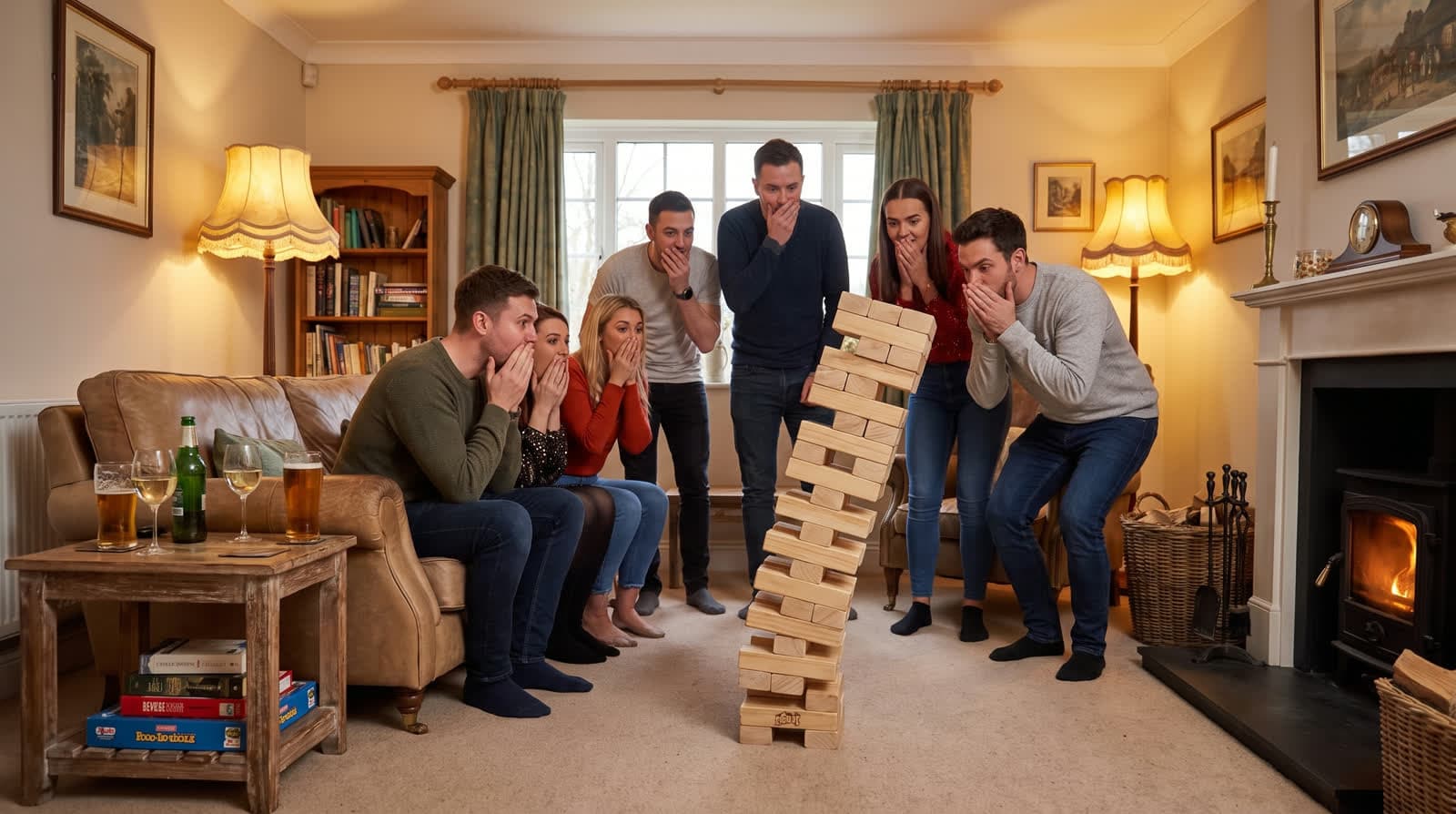
Search 'party games for adults' and two broken genres come back. The first is drinking games with the drinking lightly disguised, which excludes the pregnant guest, both designated drivers, and everyone who simply doesn't fancy ring of fire at thirty-four. The second is icebreakers that escaped from a corporate away-day, which no adult has ever enjoyed at a private party. This guide is the third option: twenty-two games that work completely sober, sorted by the room you actually have and the group you've actually invited, with a no-props section for when an evening needs rescuing at ten o'clock. It covers house parties, dinner parties and birthdays. Hen dos, stag dos and office Christmas parties are different jobs with different rules, and they have their own guides.
Sort your guests before you sort your games
Most failed games nights come from picking the wrong type of game, not the wrong game. There are three types. Conversation games are played sitting down: guessing, voting, gently betraying each other. Performance games put one person on their feet being watched — charades and all its descendants. Competition games have scores, brackets and a winner someone will mention next morning. The guests who claim to hate party games almost never hate all three; they hate performance games, and usually because someone once opened with one. The reliable order is conversation first, competition once the room is warm, performance only when it's earned — by which point the people who swore they weren't playing are the ones arguing about the rules. If what you're actually planning is the office do, the work Christmas party guide is the better read: workplace games carry politics that these don't.
| Type | What it asks of guests | Energy | Open with it? |
|---|---|---|---|
| Conversation | Sit, think, vote, mildly betray each other | Low | Yes — always |
| Competition | Score points and pretend not to mind losing | Medium | Once the room is warm |
| Performance | Stand up and be watched | High | Never cold — earn it |
The escalation only runs one way. A room that has been miming can happily sit down and vote; a room that has just arrived cannot be made to mime.
One sofa and a coffee table: up to eight people
- Wavelength, improvised. One player invents a spectrum — 'morally grey', 'overrated', 'acceptable at a funeral' — and gives a single clue; the room argues about where on the scale it lands. The boxed version is lovely, but pen, paper and opinions do the whole job.
- Codenames. Two teams, a grid of words, one-word clues from each spymaster. The best fifteen quid in party gaming, and the rare game that works equally well at 8pm sober and 1am giddy.
- Herd Mentality. Everyone secretly writes the answer they think the majority will write — best crisp flavour, most overrated film. Points for conforming. A boxed game that converts instantly to pen and paper.
- A Fake Artist Goes to Berlin. Everyone adds one pen stroke to a shared drawing of a secret word — except one player, who doesn't know the word and is bluffing their stroke. Drawing skill is irrelevant, which is exactly why it works.
- The superlatives ballot. Write categories on scraps — most likely to survive a scandal, most likely to join a cult by accident — and hold secret votes. Strictly for groups who know each other; electric in ones that do.
- Spyfall. Everyone learns the secret location except the spy, then the table interrogates itself with deliberately vague questions. Free print-and-play versions exist, and a host with sticky notes can improvise it.
A cleared living room: eight to fifteen
- Fishbowl, also sold as Monikers. Everyone writes names into a bowl, then teams guess them across three rounds: describe freely, one word only, mime only. The genius is the structure — by the mime round everyone already knows what's in the bowl, so the 'performance' has a script. The best all-round adult party game in existence.
- Werewolf. The village sleeps, the werewolves choose, the accusations begin. Needs a narrator prepared to be firm and about twenty minutes of patience while the first game teaches itself. After that it eats whole evenings.
- Reverse charades. The whole team mimes at once while a single player guesses. Flipping the ratio dissolves the embarrassment that kills normal charades — nobody is watched when everybody is flailing.
- Telephone Pictionary. Everyone writes a phrase, passes it on to be drawn, passes the drawing on to be captioned, and so on down the line. The read-out of each chain at the end is reliably the loudest ten minutes of the night. Sold as Telestrations; works fine on scrap paper.
- A minute-to-win-it circuit. Five stations of sixty-second household challenges — stack the biscuits, bounce the ball into the mug, keep three balloons airborne. Pairs well with a scoreboard on the fridge and escalates into genuine gladiatorial feeling by station four.
The whole house or garden: fifteen plus
- Two Rooms and a Boom. Guests split between two rooms with hidden roles; each round the rooms exchange hostages while the president's team and the bomber's team try to engineer the final pairing. Sounds complicated, runs itself after one round, and is the best structured use of a big house yet devised.
- The tournament bracket. Any two-player anything — table tennis, darts, giant jenga, a racing video game — becomes the spine of a party once a whiteboard bracket goes up. People who ignore games will not ignore a bracket with their name in it.
- A proper quiz. Written rounds, a picture round, a music round, a quizmaster who enjoys the power slightly too much. The format everyone claims to be bored of and nobody actually leaves.
- Assassin, clothes-peg edition. Each guest secretly draws a target and must clip a peg onto them unseen; victims hand over their own targets. Runs silently underneath the whole party and produces at least one theatrical betrayal per hour.
- Game stations. Three of the smaller games from this list running simultaneously in different rooms, rotating every twenty minutes. Solves the big-party problem where thirty people cannot share one game, and lets guests self-select their embarrassment level.
No props, no prep: six games from a standing start
Every game below starts from literally nothing — no cards, no printing, no phones. These are the reserves for when a dinner party drifts past midnight and the table wants something to happen.
- Categories. Pick a category — one-word film titles, foods that are red — and go round the circle; hesitate or repeat and you're out. Ancient, merciless, perfect.
- The question game. Conversation may proceed only in questions; answer with a statement and you're eliminated. Far harder and far funnier than it sounds.
- Fortunately, unfortunately. Build a story a sentence at a time, alternating 'fortunately' and 'unfortunately' openings. The tale degrades magnificently by round three.
- Contact. One player holds a secret word and reveals its first letter; the rest try to secretly converge on words that fit, forcing more letters out. The classic long-car-journey game, and it works just as well over dessert.
- The alphabet story. Each sentence of an improvised story must begin with the next letter of the alphabet. Q and X arrive like unexploded ordnance.
- Two truths, rehabilitated. The icebreaker becomes an actual game when the room votes on the lie and the liar scores a point per wrong vote. Stakes fix what HR broke.
The games that fail, and the mechanism behind it
The failures are predictable. Drinking games fail because they price out whoever isn't drinking, and roughly a third of any grown-up party isn't — pregnancy, driving, medication, or plain preference. Icebreakers fail because they were designed to force intimacy between strangers, and deploying one on friends signals you've confused your party with an induction day. And cold performance games fail for the most instructive reason of all: cringe is simply attention without a script. One person, all eyes, no structure to hide inside — that's the entire chemistry of the wince. Every good game above defuses it the same way, with rules, roles or teams that give the watched person something to be doing. Fishbowl's mime round works where charades dies because round one already wrote everyone's script.
When to hire the games in
There's a level of party — the fortieth, the anniversary, the garden party for sixty — where the host stops being a guest because they're running the entertainment all night. That's the honest threshold for hiring the centrepiece instead. In the mainstream UK market (August 2026), most single-piece party hire — magicians, casino tables, photo booths, garden-games bundles — lands somewhere roughly between £150 and £600 depending on hours and distance, with hosted formats at the top of the band because a person costs more than kit. Our own offering sits in that hosted bracket: MyVREvents runs hosted VR sports tournaments — golf, racing, archery, clay shooting among them — brought to homes and venues UK-wide, with evening events from £395 for two hours including the host, the leaderboard, travel and setup; each station needs a 3m x 3m corner and a socket, and no VAT is added because we're not VAT registered. Details on the VR party hire page. For the specific case of milestone birthdays, the VR birthday parties guide breaks formats down by age and venue.
FAQs
What are good party games for adults that don't involve drinking?
Which party games need no props or preparation at all?
How do you get reluctant adults to actually join in?
How many games should you plan for one party?
What's the best party game for a large group of adults?
Planning the event this guide describes?
Date, headcount, city — quotes back within one working day.