Exhibitions
VR on an Exhibition Stand: Footfall, Dwell Time and Actual Leads
Published 27 July 2026
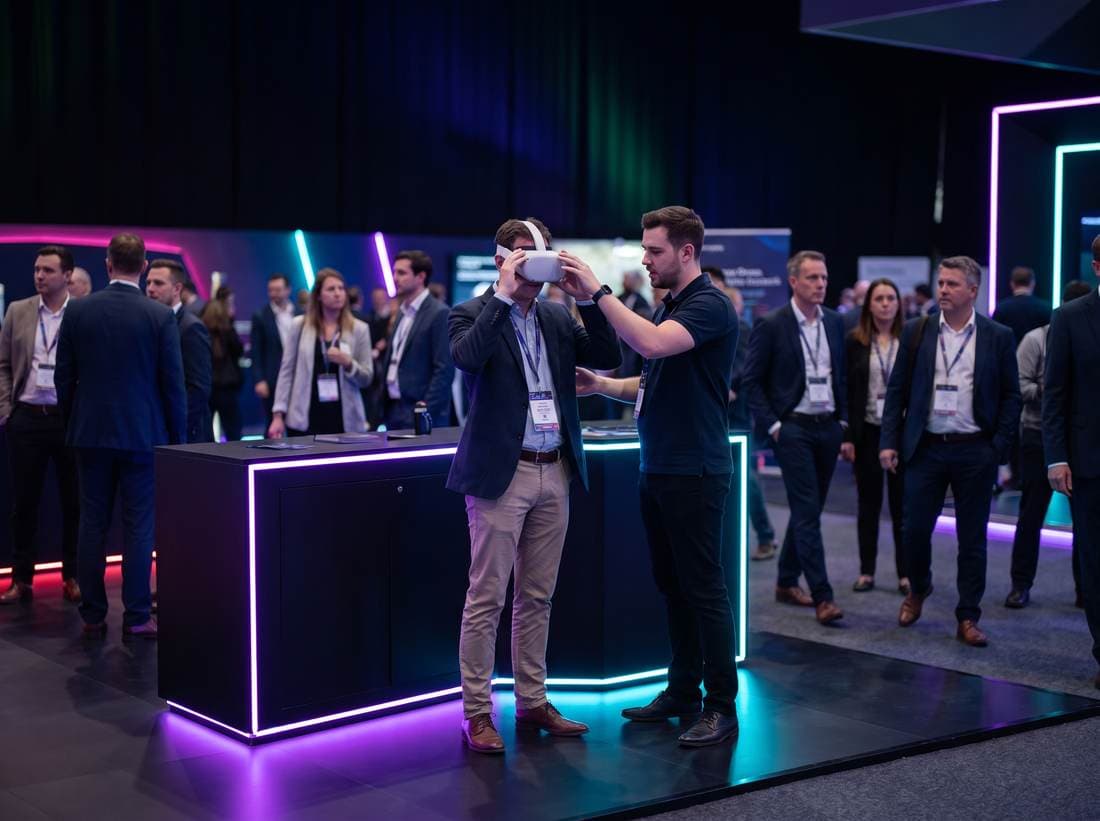
Exhibition stands have one job on day one: stop people walking past. Most attempts at this fail because they stop the wrong people — a crowd of delegates enjoying free sweets isn't a pipeline. VR does stop footfall, reliably and visibly, but whether that turns into leads depends almost entirely on decisions you make before the show. This is what actually matters: throughput maths, where the screen goes, how you capture a name without killing the atmosphere, and what it costs.
Why it stops people
The mechanic is simple and it works because of the screen, not the headset. A person in a headset is mildly interesting. A person in a headset whose view is mirrored on a large screen, with a lap time or a score climbing in real time, is a spectacle you can read from thirty metres down the aisle.
That's the whole trick. Passers-by understand what's happening without being told, they can see whether the current player is any good, and a crowd forms because watching costs nothing. The queue is the advertisement.
The throughput maths nobody does
Here's where stands go wrong. Work out how many visitors you want to engage across the show, then check whether your setup can physically deliver it.
| Setup | Visitors per hour | Over a 7-hour day | Over a 3-day show |
|---|---|---|---|
| One station, 3–4 min turns | 15–20 | ~120 | ~360 |
| Two stations | 30–40 | ~250 | ~750 |
| One station, 90-second turns | 35–40 | ~270 | ~800 |
Shorter turns raise throughput but reduce the impression each visitor takes away — pick deliberately.
The tension is real: long turns create better memories and fewer conversations; short turns do the reverse. For a lead-generation stand we'd usually run shorter turns and more of them. For a brand or launch stand where the point is the impression, longer turns and a bigger screen serve you better.
Capturing the lead without ruining the moment
The worst version of this is a clipboard between the visitor and the headset. It converts a moment of delight into a transaction and people simply walk on.
- Put the name capture after the play, not before. They've had the experience, they're pleased, and giving a badge scan feels like a fair trade.
- Use the leaderboard as the reason. "Want your score on the board? I'll need a name." It's honest, it's optional, and it works far better than an offer of a brochure.
- Badge scanners beat forms. Most shows provide them, and one scan is a second of friction rather than a minute.
- Prize at the end of the day for the top score. It gives you a legitimate reason to hold contact details and a legitimate reason to email afterwards.
Do that and the tournament runs your stand for you — visitors return to check whether their score has held, which is a second conversation you didn't have to chase.
Stand space and the power order
One station fits a 3m × 3m footprint, which is a corner of most 6m × 3m stands. What matters more than floor area is where the screen faces: it should be readable from the aisle, not from inside your stand. A screen pointed inward entertains your own staff.
Power is one standard socket per station — roughly 500W, which goes on the organiser's power order form. We'll tell you exactly what to tick. Dock access and build slots run to the exhibitor manual, which we work to as a matter of course. The space and power guide covers the technical detail.
Branding it
The leaderboard screen can carry your logo, campaign name or product messaging, which means the thing everyone is looking at is also the thing carrying your brand. That's a considerably better use of attention than a pull-up banner nobody reads. For launches, a single hero experience tied to the campaign beats a variety of stations.
What it costs
Full-day branded activations start at £2,450, covering multi-station setups with branding for exhibitions, conferences and brand days. Across the wider market, branded corporate activations run £5,000–£6,500 and up at the operators who publish anything at all — the comparison is in our cost guide.
Set against the cost of the stand space itself, the maths usually favours spending on something that makes the space work rather than on more space.
Staffing your stand around it
Our host runs the VR — fitting headsets, managing the queue, keeping the leaderboard moving. What they cannot do is qualify your leads, and you shouldn't want them to. The pattern that works is one of your people standing just beyond the play area, talking to whoever is watching rather than whoever is playing.
That distinction matters. The person in the headset is occupied and can't hold a conversation. The three people waiting their turn are standing still, mildly entertained and entirely available — which makes them the easiest audience you'll get all show. Staff the queue, not the station.
Which experiences suit a stand
[VR Racing](/vr-racing) is the strongest footfall-stopper we run — a lap-time board is instantly legible and creates genuine competition between strangers. [VR Drone Racing](/vr-drone-racing) is the close second and lands especially well at technology and engineering shows. [VR Golf](/vr-golf) suits a more senior, conversational stand where you want visitors to stay and talk. [VR Archery](/vr-archery) works where floor space is tight and turns need to be quick.
We work exhibition stands across the UK, from the NEC in Birmingham and ExCeL in London to the Harrogate Convention Centre and Telford International Centre. Send us your hall and stand number and we'll spec the build to your footprint.
FAQs
How many visitors can we get through in a day?
How much stand space does it need?
Can the leaderboard carry our branding?
What do we need to order from the organiser?
How do we capture leads without killing the atmosphere?
Planning the event this guide describes?
Date, headcount, city — quotes back within one working day.